AIM 1980'S
1980
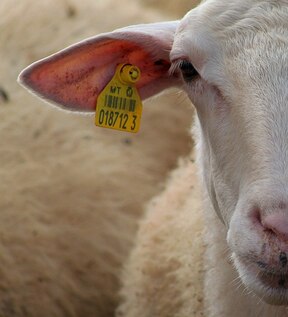
The earliest non-military application of Radio Frequency Identification (RFID) occurred when Identification Devices developed RFID tags for farm animals.
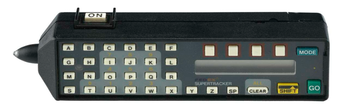
Federal Express began tracking air bills with 11-digit Codabar symbols. Contemporary FedEx packages are labeled using Code 128 and PDF417.
Federal Express SuperTracker is from 1986
1981
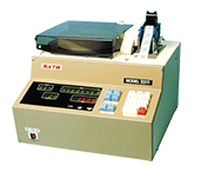
First thermal transfer bar code printer by Sato
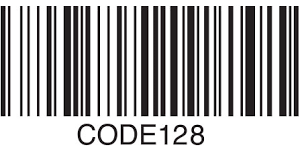
Code 128, a space efficient, alphanumeric bar code was created by Ted Williams and introduced by Computer Identics
Used in Supply Chain, Distribution, Tracking & Healthcare
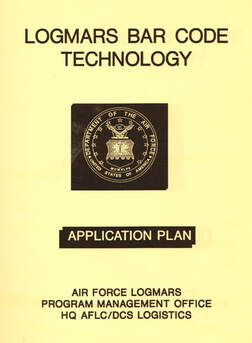
LOGMARS - DoD
On September 1, 1981, the United States Department of Defense adopted the use of Code 39 for marking all products sold to the United States military with a system called LOGMARS. This adoption of the bar code for military applications significantly pushed the bar code into numerous industrial applications to follow.
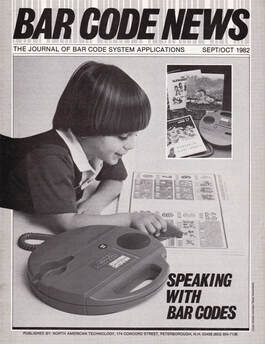
The first issue of “Bar Code News” rolled off the presses.
The Automotive Industry Action Group (AIAG) was formed to publish standards for vehicle manufacturers and their suppliers.
1982
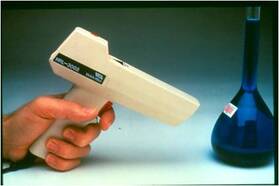
First Hand Held Scanner
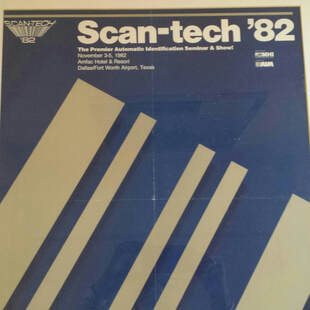
First SCAN-TECH Held in Dallas with 1100 attendees and 61 exhibitors.
First CCD Scanner Introduced
Norand
The US Department of Defense required 50,000 of its suppliers to label new procurements with CODE 39 bar code symbols.
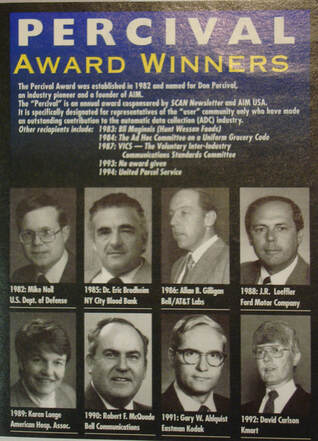
Don Percival Award Established
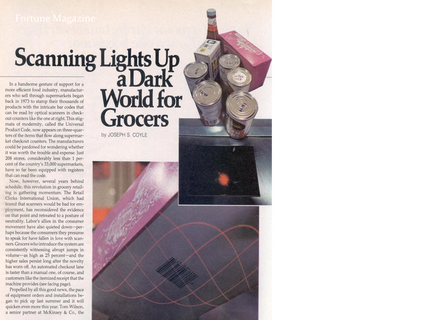
Fortune Magazine publishes an article "The Bar Coding of America".
1983
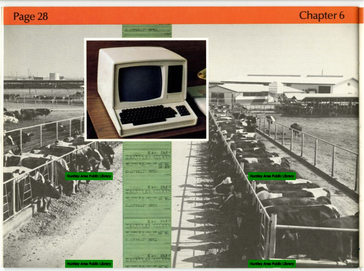
The first RFID system designed to identify dairy cattle for automatic individualized feeding was shipped to Babson Bros., of Oak Brook, Illinois.
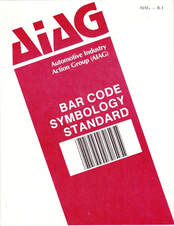
The Automotive Industry Action Group (AIAG) published “Bar Code Symbology Standard 3-of-9”, thus adopting Code 39 as its standard. AIAG will be the first industry to use “data identifiers” to indicate the type of data in the bar code symbol.
1984
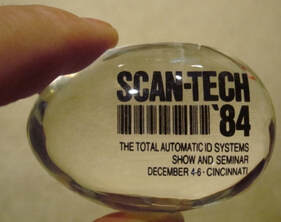
SCAN-TECH 84 held in Cincinnati with 5,000 attendees and 140 exhibitors.

LA Olympics used bar code for tracking & security
First SCAN-TECH Europe held in Amsterdam, Netherlands
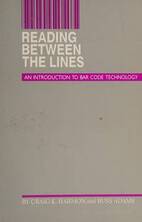
The bar code industry’s first textbook, “Reading Between the Lines”, by Craig K. Harmon and Russ Adams, was published.
AIM creates the annual “Richard Dilling Award”. The first person receiving this award was Ed Andersson of Computer Identics Corporation.
1985
SCAN-TECH 85 held in Baltimore with 7,000 attendees and 160 exhibitors.
AIM became incorporated as a separate trade association from MHI
Had 85 member companies at this time
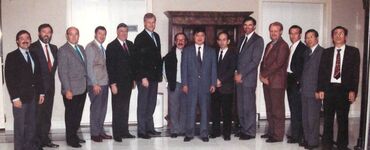
Inaugural Meeting of AIM Europe help in Brussels, Belgium.
AIM UK established.
First Issue of Automatic ID News is published
SCAN Pacific held with 100 attendee and 26 exhibitors.
1986
SCAN-TECH 86 held in San Francisco with 4100 attendees and 200 exhibitors.
AIM Pacific established to include Australia, New Zealand, and South East Asia.
AIM embarks on a "Symbology Performance Test" in partnership with State University of New York at Stony Brook.
This test involved 7 symbologies, more than 10 densities, 8 readers/scanners and labels produced by 12 printing techniques.
AIM establishes the Richard Dilling Scholarship Fund to support students who choose a career path in AIDC.
1987
SCAN-TECH 87 Kansas City
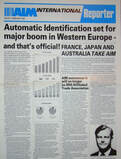
AIM International Newsletter Published
1988
Scan Moscow’88 – 1st Auto ID Conference & Exhibition in Russia, co-sponsored by AIM Europe and the Soviet Chamber of Commerce & Industry
Ohio University establishes the Center for Automatic Identification
1989
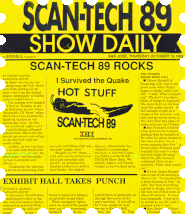
SCAN-TECH 89 held in San Jose with 9600 attendees and 230 exhibitors. SCAN-TECH was dubbed "SCAN-QUAKE" and is still referred to as this for many in the industry.
At the end of the opening day of the event – October 17, 1989 at 5:04pm – a 7.1 earthquake hit with the epicenter in Mt. Loma Prieta (only 22 miles from San Jose). The quake killed 63 people throughout northern California, injured 3,757 and left some 3,000-12,000 people homeless.
AIM & the Voluntary Interindustry Communications Standards (VICS) jointly launch a new conference - the QuickResponse Conference & Show. The event ran annually through 1995, then changed names to the "IQ" event that ran until 1997 when VICS became the sole sponsor of the event. Eventually VICS becomes the merchandise group within GS1 US.
AIM International Formed with AIM Europe/Denmark, AIM UK, AIM France, and AIM Espana and opened affiliate offices in West Germany, Austria, Switzerland and Budapest.
Thank you to our sponsors!