
The views and opinions expressed in this article are those of the author and do not necessarily reflect the official policy or position of AIM Global
As RFID adoption continues to mature across manufacturing and distribution, the conversation is shifting.
It’s no longer about whether RFID works. That’s been established. Accuracy, automation, and hands-free data capture are well understood. The real challenge many organizations now face is what happens after the read.
Specifically, how RFID data is integrated into core enterprise systems.
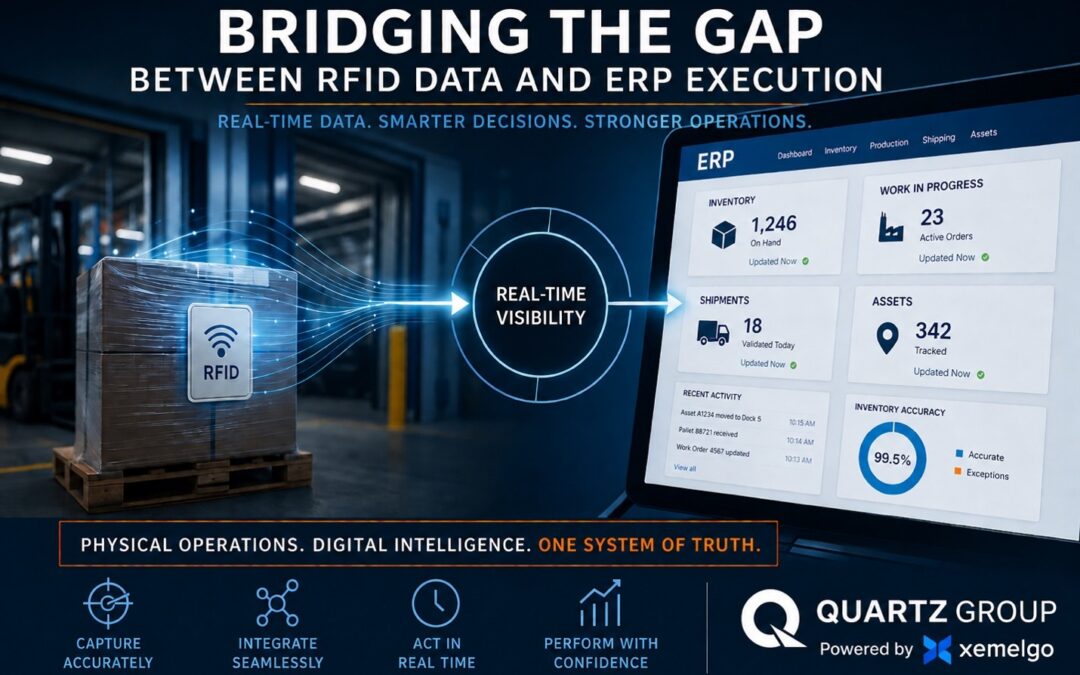
In many environments, RFID operates alongside the ERP rather than within it. Data is captured effectively at the edge, but delays, middleware complexity, or batch processing can limit its impact on real-time decision-making. The result is a familiar gap between physical operations and system-of-record updates.
This is where the next phase of RFID maturity is emerging.
Organizations are increasingly prioritizing tighter integration between RFID platforms and ERP systems like Epicor Kinetic and Prophet 21. The goal is not simply visibility, but operational alignment, where events in the physical world immediately influence system workflows.
When RFID data is fully integrated into ERP processes, several capabilities become more accessible:
- Inventory accuracy transitions from periodic validation to continuous awareness
- Work-in-progress tracking reflects actual movement rather than last recorded transactions
- Shipping and receiving processes can be validated automatically at key transition points
- Asset tracking becomes less dependent on manual input and more reflective of real-time location data
These shifts are less about new technology and more about how existing technologies are implemented.
One approach gaining traction is the concept of an “ERP-native” RFID layer, where RFID events are treated as first-class system transactions rather than external inputs. Platforms such as Xemelgo are designed with this model in mind, enabling more direct integration with enterprise workflows.
For organizations already invested in RFID infrastructure, this raises an important question:
Is your current deployment simply collecting data, or is it actively driving system behavior?
As the industry continues to evolve, the distinction between those two approaches will likely define the next wave of operational performance gains.
Visibility is a choice.
More organizations are choosing to close the gap between what their systems say should happen and what is actually happening on the floor.
See what real-time visibility looks like at https://quartztrack.com
One of India’s leading private universities, with a campus population of over 70,000 students, faculty, and staff, set out to modernize its campus operations through intelligent automation. The objective was clear: deploy a scalable, secure, and reliable AIDC-based solution that could simplify attendance tracking, automate entrances, and streamline student leave management, while supporting high user volumes and daily peak traffic.
To achieve this, ID Tech Solutions designed and implemented a fully integrated AIDC Technology Solution combining facial recognition devices, automated turnstiles, and centralized management software.
Solution Overview
The deployed solution covers three core operational areas:
- Attendance Management
- Entrance Automation
- Student Leave Management
The system includes 400 advanced facial recognition devices with a user capacity of up to 1 lakh users, ensuring scalability well beyond the university’s current requirement of 70,000 users. These devices are strategically installed across academic buildings, hostels, and campus entry points to capture attendance and access events in real time.
For secure and controlled access, IDT T8000 heavy-duty motorized turnstiles were deployed at key entrances. Designed for high-traffic environments, the turnstiles offer fast response times, smooth throughput, and reliable operation during peak hours, making them ideal for large educational campuses.
Technical Innovation through AIDC
The facial recognition devices enable contactless identification, eliminating the need for ID cards or manual registers. With high-speed face matching, large template storage, and accurate detection, the system ensures:
- Fast user authentication
- Elimination of proxy attendance
- High accuracy even during crowd movement
The AIDC framework automatically captures entry, exit, and attendance data and syncs it with the central platform. This real-time data flow provides administrators with instant visibility into campus activity.
The student leave management module integrates seamlessly with the access control system. Approved leaves are automatically reflected in access permissions, reducing manual verification and ensuring compliance with university policies.
Operational Impact
The implementation has significantly improved overall campus operations:
- Attendance processes are now fully automated, saving time for faculty and administrative staff
- Entrance automation has improved security and crowd management, especially during peak hours
- Manual effort and paperwork have been reduced, improving operational efficiency
- Real-time data availability supports faster decision-making and better planning
The system has also enhanced the student experience by enabling smooth, contactless movement across campus while maintaining strict access control.
About ID Tech
With nearly two decades of experience, ID Tech specializes in automating identity, security, and traceability through innovative and reliable AIDC technologies. Our solutions are designed to simplify operations, improve accuracy, and enhance security across high-volume environments.
ID Tech (https://www.idsolutionsindia.com/) is a trusted partner for India’s leading universities, where our solutions are widely used to automate student attendance, library systems, entrance and access control, and other campus operations. By combining technologies such as RFID, facial recognition, biometrics, and automated access systems, we help institutions build smart, secure, and future-ready campuses.