
AIM Community and Innovation Take Center Stage at LogiMAT 2026
The 2026 LogiMAT show was a great success for AIM and its members as the show recorded the highest number of visitors ever.
Once again, the AIM Community Booth was completely sold out.
Participating members included:
BlueStar / Checkpoint / Deister Electronic / Dynamic Systems / Fraunhofer IIS / Gustav Wilms / Microsensys / Modi / SATO / Schneider-Kennzeichnung / Schreiner Group
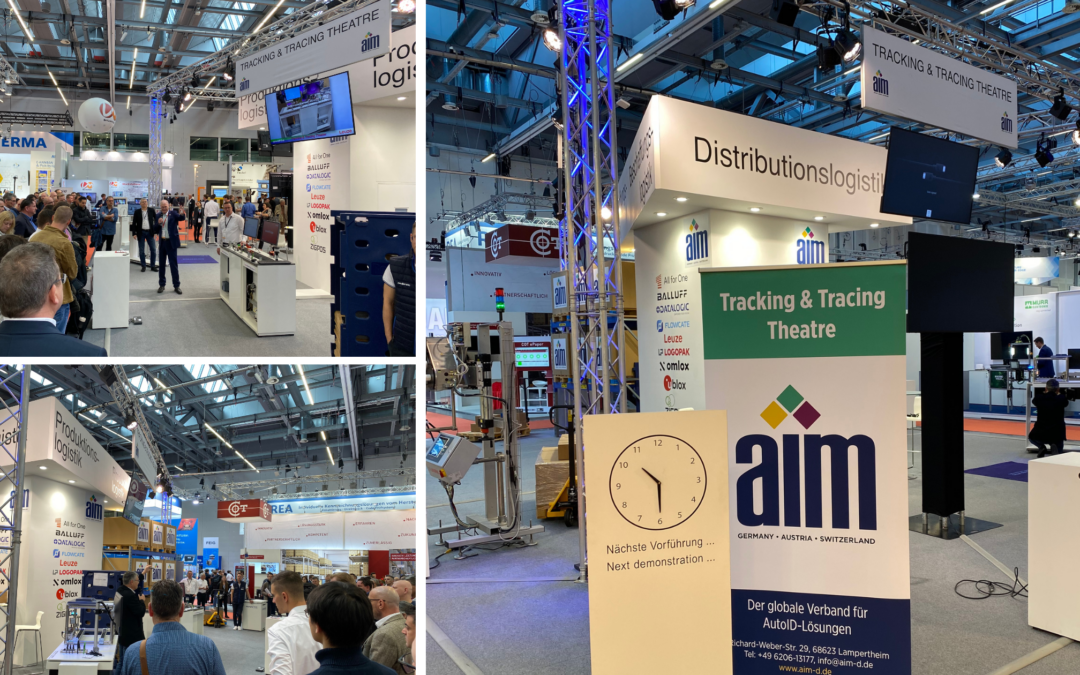
The three daily shows in the AIM Tracking & Tracing Theater attracted even more visitors than in previous years. Immediately after the sessions, the T&TT partners were able to follow up with interested visitors and reported very promising leads.
The T&TT Show partners for 2026 were:
All for One Group / Balluff / CANCOM / Datalogic / Leuze / Logopak / Omlox (PNO) with Flowcate and SynchronicIT
Demonstrated solutions included Print & Apply solutions, commissioning processes, AIDC solutions for production processes, AI-supported quality management using vision systems, RTLS solutions, and data integration into ERP and SAP systems. Once again, it was especially interesting to see that we were able to attract non-members to the Tracking & Tracing Theater (in contrast to the AIM Community Booth, which is reserved exclusively for members).
In the AIM ident-Experts Forum, Leuze, Balluff, and Microsensys delivered insightful presentations on how AIDC technologies are enabling the digitalization of the supply chain.
Looking ahead to 2027, next years LogiMAT will be held in Stuttgart, Germany on March 16-18.

MODEX 2026 Recap: Powered by Data, Driven by Community
This week at MODEX 2026 in Atlanta, I had the opportunity to spend time walking the show floor, reconnecting with many AIM members, meeting new industry professionals, and seeing firsthand where the material handling and supply chain market is headed. One of the highlights for me was stopping by member booths throughout the week to chat, catch up on what they are working on, and record short videos that we have been sharing on AIM’s social media channels. It was a great way to spotlight the innovation our members are driving while also giving others a look at the people and technologies helping shape the future of supply chain execution.
Another major highlight was our AIM Unwind After 5 networking event on Tuesday evening at Margaritaville, just outside the Georgia World Congress Center. AIM invited members, partners, and industry friends to join us for an informal get-together, and the response was fantastic. With the first drink on AIM, the setting created the perfect opportunity for people to step away from the busy show floor, relax, and have real conversations. What stood out most was how naturally the discussion flowed. People talked about current industry challenges, emerging opportunities, and what they are seeing in the market, but in a fun, low-pressure setting that made it easy to connect. In fact, many attendees stayed well beyond the planned time because the conversations were simply that fun.
As I moved through MODEX, one thing became very clear: the industry continues to push toward more connected, intelligent, and scalable operations. A major theme across the show was the continued importance of Warehouse Management Systems (WMS) as a long-term growth platform. More companies are looking at WMS not just as software to manage inventory or labor, but as a way to also handle new customer demands. That has direct relevance to AIM and our members because the value of a WMS is only as strong as the quality and timeliness of the data flowing into it. This is where AIDC technologies like barcode, RFID, machine vision, mobile computing, and real-time data capture continue to prove essential.
Another clear trend was the evolution of Automated Storage and Retrieval Systems (ASRS). Many conversations and presentations at the show were touching on how ASRS provides measurable ROI, flexibility, resilience, and the ability to support any kind of fulfillment demands. For AIM, this reinforces something we have long advocated, that automation works best when it is built on reliable identification, visibility, and interoperability. Whether an operation is using conveyors, robotics, or some form of artificial intelligence, the ability to accurately identify items, locations, and assets remains the key component.
Speaking of AI, I also saw strong momentum around AI-enabled supply chain execution and the need for systems to work more intelligently together. Many of the discussions and sessions at MODEX centered on how AI can help in spaces like warehouse, transportation, and in order management systems. End-to-end visibility was not surprisingly a major theme throughout the show. For AIM, that is an important reminder that our technologies sit at the center of this transformation. AI and other platforms are only as powerful as the trusted data they receive, and AIDC is what helps create that trusted data layer.
To everyone I had the chance to meet this week, thank you for the conversations and the time spent sharing ideas. For those I met at MODEX who are not yet part of AIM, I would encourage you to take a closer look at what our community is building. AIM is a vibrant network of innovators, educators, standards leaders, and solution providers working together to move this industry forward. Reach out to me and we can touch base and get you into our network! Looking forward to building upon the many discussion points gained from the show

Metalcraft Announces Kathleen Phillips as Vice President of Sales; Marianne Alvarado to Retire After 26 Years of Service
(MASON CITY, IA, April 1, 2026) — Metalcraft, a leading manufacturer of identification products, is pleased to announce the appointment of Kathleen Phillips as Vice President of Sales, effective April 1, 2026. Phillips will succeed Marianne Alvarado, who will retire in September after an exceptional 26-year career with the company.
In her new role, Phillips will be responsible for leading and overseeing all aspects of Metalcraft’s sales operations, driving revenue growth, strengthening customer relationships, and advancing the company’s go-to-market strategy.
“We are excited to welcome Kathleen to Metalcraft,” said Kyle Bermel, CEO at Metalcraft. “Her strategic vision, customer-focused mindset, and history of driving growth make her the ideal leader to guide our sales organization into the future.”
Phillips brings extensive experience in global sales leadership, strategic partnerships, and channel development. Most recently, she served as Vice President of Partnerships and Strategic Alliances at Jitterbit, where she led partnership initiatives and contributed to revenue growth. Prior to that, she held senior leadership roles at Digital River, Entrust,
Bluestem Brands, and HID Global, where she was responsible for sales, partnerships, and marketing functions.
“I am honored to join Metalcraft as Vice President of Sales,” said Phillips. “Metalcraft has a strong reputation for innovation and customer commitment, and I look forward to working with the talented sales team to build on that legacy and drive continued success.”
Marianne Alvarado will continue in her role through September to ensure a smooth transition. Over her 26 years with Metalcraft, Alvarado has made a lasting impact on the organization, serving as a Direct Sales Representative, Sales Manager, and most recently Vice President of Sales. Her leadership has been instrumental in developing the company’s
sales strategy and fostering a strong, customer-focused culture.
“Marianne’s contributions to Metalcraft over the past 26 years have been extraordinary,” said Bermel. “Her dedication, leadership, and commitment to our customers have helped shape who we are today. We are deeply grateful for her service and wish her the very best in her well-earned retirement.”
Alvarado joined Metalcraft in 2000 and has played a key role in the company’s growth and success, culminating in her promotion to Vice President of Sales in 2023.
About Metalcraft
Metalcraft has provided property identification solutions since 1950. What began as a
solution for the Bostitch Stapler Company’s identification needs has evolved into
Metalcraft as we know it today—a strong, innovative, growing company driven by its
corporate values and the Metalcraft Compass. As member-owners, Metalcraft employees
take pride in delivering the right product with the right technology to exceed customer
expectations.
Media Contact:
Julia Deets
VP of Marketing and CX
juliad@idplate.com
AIM Activity Overview
March 2026
AIM continues to advance its mission of enabling the adoption, growth, and interoperability of AIDC technologies through active work groups, regulatory engagement, standards development, and global chapter collaboration. The following provides a high-level overview of current initiatives and activities across the AIM community.
Digital Product Passport (DPP) Task Force
Liaison | Michael Allen
The Digital Product Passport Task Force continues to monitor and engage with emerging European standards related to product traceability and lifecycle transparency. The group reviewed draft standards most relevant to AIDC technologies and submitted formal comments through the German Standards Organization (DIN). The task force is awaiting feedback before determining next steps and scheduling future discussions.
RFID Experts Group (REG)
Chair | Jerry Peyton, VISTA IT Systems
The RFID Experts Group remains highly active across multiple initiatives focused on industry education, standards awareness, and regulatory advocacy.
Key activities include:
- Monitoring regulatory developments related to the 902–928 MHz spectrum and potential impacts on RFID deployments.
- Development of a whitepaper on RFID Security and Privacy aimed at providing clear guidance to organizations evaluating RFID systems.
- Creation of educational resources explaining various wireless technologies used within the AIDC ecosystem, including BLE, NFC, and UWB, and how they complement RFID solutions.
- Updating foundational educational resources such as the RFID glossary and introductory materials.
- Collaboration with industry partners on RFID educational guidance for the retail sector.
- Finalization of additional technical documentation and identification of areas requiring updates to RFID data content standards.
- Contributing expertise to the development of an upcoming AIM Virtual RFID event, which will focus on industry trends, technology understanding, and real-world deployment considerations.
Visibility Technologies Industry Group
Chair | Dan Quagliana, Seagull
The Visibility Technologies Group continues to focus on regulatory developments, supply chain traceability, and the role of AIDC technologies in improving operational transparency.
Current initiatives include:
- Reviewing FDA draft guidance related to cosmetic product traceability under the Modernization of Cosmetics Regulation Act (MoCRA), with the goal of developing coordinated AIM comments emphasizing how AIDC technologies support compliance and supply chain transparency.
- Revising foundational guidance on track-and-trace technologies and supply chain visibility.
- Developing visual educational materials that illustrate how different AIDC technologies work together across product lifecycles and supply chains.
- Monitoring developments related to the FCC IoT Cybersecurity Labeling Program, including forthcoming technical standards and testing requirements associated with the Cyber Trust Mark initiative.
Next meeting March 11 at 11 AM ET
Technical Symbology Committee (TSC)
Chair | Steven Keddie, GS1 GO
The Technical Symbology Committee continues to support barcode and identification standards development, interoperability, and education.
Current projects include:
- Finalizing guidance related to healthcare barcode scanner configuration, supporting proper implementation of symbology identifiers in healthcare environments.
- Developing standardized Fixed Pattern Damage (FPD) test symbols to help ensure consistent barcode verifier performance across manufacturers.
- Evaluating potential updates to the AIDC Layman’s Guide, which may require modernization to reflect evolving industry practices.
- Producing educational material addressing mobile scanning technologies, including considerations related to modern camera-based scanning solutions.
- Monitoring the status of the Ultracode standard currently under ballot within ISO/IEC committees.
Community Engagement Initiatives
Women of AIDC
Liaison | Bethany Deane
The Women of AIDC initiative continues to foster professional networking and leadership development for women in the automatic identification industry. Virtual events and guest speaker sessions are helping build a supportive community while highlighting leadership perspectives and industry experiences.
Young Professionals of AIDC
Liaison | Michael Allen
The Young Professionals initiative is focused on strengthening engagement with the next generation of AIDC leaders. Current efforts include defining program goals, gathering community feedback through surveys, and exploring new ways to support mentorship, networking, and industry education.
Global Chapter Collaboration
AIM’s regional chapters remain instrumental in expanding awareness of AIDC technologies, advancing standards adoption, and supporting regional regulatory engagement.
Key global initiatives include:
Industry Education and Outreach
Chapters continue hosting educational events, webinars, and workshops to promote understanding of identification technologies across industries including healthcare, manufacturing, supply chain logistics, and retail.
Standards Development and Regulatory Advocacy
Several chapters remain actively involved in national and international standards organizations, helping align regional initiatives with global ISO standards and supporting regulatory compliance programs involving traceability, digital labeling, and cybersecurity.
Digital Transformation and Traceability
Regional initiatives are supporting emerging regulatory and industry requirements such as Digital Product Passport programs, 2D barcode adoption, and enhanced supply chain transparency.
Technology Adoption and Implementation
Many chapters are actively supporting deployments of AIDC technologies such as RFID, Data Matrix, and digital labeling, helping organizations improve product identification, regulatory compliance, and operational visibility.
ISO and Registration Authority Activities
ADC1 Technical Advisory Group (TAG)
Secretariat | Mary Lou Bosco
As the Secretariat for the U.S. Technical Advisory Group to ISO/IEC SC31, AIM continues to support global standards development and registration services.
Activities include:
- Managing registration programs for unique identifiers and RFID tag identifiers
- Supporting standards related to RFID data encoding and interoperability
- Maintaining registration databases and processing new applications as needed
These activities help ensure global interoperability of automatic identification systems and support industry adoption of standardized identification structures.
Regional Chapter Highlights
Across AIM’s international chapters, organizations continue to strengthen collaboration through educational programs, regulatory engagement, and technology implementation initiatives. Areas of focus include:
- Digital Product Passport and sustainability initiatives
- Supply chain traceability and transparency
- Food safety and medical device identification programs
- Transition toward 2D barcode and digital link standards
- Support for national digital transformation initiatives
- Industry certification, education, and workforce development programs
These efforts demonstrate AIM’s continued global leadership in advancing identification technologies and supporting digital transformation across industries. IF you would like to learn more about any of these initiatives, contact Michael Allen.
Global Collaboration and Industry Momentum Highlighted at AIM Quarterly Chapter Meeting
The most recent AIM Quarterly Chapter Meeting brought together chapter leaders and global representatives to share updates, discuss strategic priorities, and reinforce collaboration across the Automatic Identification and Data Capture (AIDC) ecosystem. The meeting reflected AIM’s continued commitment to advancing standards, education, advocacy, and membership engagement worldwide. Chapters provided insights into regional activities, regulatory developments, educational initiatives, and industry adoption trends, while AIM Global outlined strategic initiatives designed to strengthen collaboration and expand industry influence.
Below is a breakdown of key highlights from each regional chapter and AIM Global initiatives.
AIM Germany, Austria, and Switzerland (AIM-D)
AIM-D provided a comprehensive overview of its continued leadership in European standardization and regulatory advocacy. The chapter remains heavily engaged in regulatory initiatives including the Radio Equipment Directive, Cyber Resilience Act, cybersecurity frameworks, and Digital Product Passport development. The organization is also supporting frequency harmonization for RFID bands and addressing interference concerns, demonstrating strong advocacy for industry needs.
AIM-D is advancing technical collaboration through initiatives such as the Global Positioning Group focused on RTLS standardization and ongoing work in systems integration, including RFID and IO-Link interoperability. The chapter continues to expand its thought leadership through expert working groups, certification efforts, and market research activities.
From a membership and engagement standpoint, AIM-D acknowledged challenges related to regulatory pressures, workforce shortages, and market conditions. Despite these challenges, the chapter successfully launched a new website and LinkedIn presence while planning several major industry events and conferences to support community engagement and technical collaboration.
AIM Russia
AIM Russia highlighted its strong focus on standards development, advocacy, and education. The chapter continues to serve as a key contributor to national and international AIDC standardization through its participation in ISO and regional technical committees.
Recent accomplishments include the adoption of updated Data Matrix and high-capacity automatic data capture media standards aligned with international ISO specifications. AIM Russia is also playing an important role in supporting national traceability programs that leverage RFID and Data Matrix technologies to enhance product identification and supply chain visibility across multiple sectors.
The chapter remains active in providing technical training and consultation services to support implementation of these traceability initiatives, reinforcing the importance of standards adoption and user education across the region.
AIM India
AIM India celebrated significant growth and engagement as it marked its third anniversary. The chapter continues expanding awareness of AIDC technologies through webinars, exhibitions, and participation in major industry conferences across sectors including healthcare, manufacturing, and digital transformation.
A major focus for the chapter moving forward is leveraging Corporate Social Responsibility (CSR) funding to expand educational outreach and workforce development initiatives. AIM India has also demonstrated strong momentum in promoting AIDC adoption across healthcare and medical device applications, further supporting national digital transformation initiatives.
The chapter continues building partnerships with industry organizations and government bodies to promote skill development and operational efficiency through AIDC technologies.
AIM North America
AIM North America reported continued success in expanding industry collaboration and educational initiatives across multiple vertical markets. The chapter highlighted the success of its membership engagement programs, including gift membership campaigns and community networking events.
Several workgroups remain highly active, including the Food Supply Chain Work Group addressing regulatory compliance and food safety challenges, the UDI Work Group supporting medical device traceability and Sunrise 2027 transition to 2D barcodes, and the Cannabis Work Group focusing on regulatory compliance and traceability innovation.
The chapter continues strengthening partnerships with organizations while expanding podcast and educational content designed to support industry knowledge sharing and best practices.
AIM Asia
AIM Asia reported significant progress in launching its Digital Product Passport (DPP) Workgroup. The initiative focuses on key industries including garments, semiconductors, food, and pharmaceuticals, reflecting growing global demand for product transparency and lifecycle traceability.
The chapter is also developing a regional digital collaboration platform designed to improve communication, resource sharing, and engagement among members throughout the Asia-Pacific region. These initiatives demonstrate the chapter’s commitment to supporting regional digital transformation and strengthening global alignment on regulatory compliance and traceability solutions.
AIM Denmark
AIM Denmark continues to play an important role in advancing knowledge-sharing and industry collaboration around digital transformation and Digital Product Passport implementation. The chapter hosted multiple events focused on data utilization, digital labeling, and traceability.
Educational outreach remains a key focus, including AIDC web series and site visits to showcase real-world technology implementation. AIM Denmark continues to provide engagement opportunities through targeted educational programs and industry partnerships.
AIM Japan
AIM Japan continues to prioritize educational expansion and industry collaboration. The chapter is actively working with organizations to host AIDC 101 educational workshops and is pursuing sponsorship opportunities to support program delivery.
The chapter is also strengthening relationships with international organizations, including GS1 China and regional partners, to promote adoption of AIDC technologies across Asia. These initiatives reinforce AIM Japan’s commitment to education, standardization, and global collaboration.
AIM Korea
AIM Korea continues to support the transition from traditional 1D barcodes to GS1-based 2D digital link standards through its Smart Food QR initiative. The project is being implemented in collaboration with the Ministry of Food and Drug Safety and GS1 Korea to enhance consumer access to food safety and product information.
This initiative represents a significant step toward digital labeling adoption and improved transparency across food supply chains in Korea.
AIM Europe
AIM Europe emphasized its continued leadership in regulatory advocacy and technical standardization. The chapter remains highly engaged in EU regulatory discussions, including cybersecurity, radio equipment regulations, and interference mitigation initiatives. It also continues to support Digital Product Passport implementation efforts through collaboration with standards organizations and government bodies.
AIM Global Initiatives and Strategic Direction
AIM Global reinforced its strategic priorities centered on standards development, advocacy, education, and community building. The organization continues to play a central role in global regulatory advocacy, including responses to spectrum and positioning technology proposals that may impact RFID operations and support for Digital Product Passport standardization efforts.
Educational initiatives remain a major focus, including continued expansion of AIDC 101 and 102 workshops, industry research initiatives, and publication of industry trend reports. AIM also highlighted the Case Study Competition as a platform to showcase innovative AIDC applications and industry success stories.
To support member and prospect engagement, AIM is enhancing digital resources including a new Member Hub, Prospect Gateway, improved member directories, and exploration of mobile event applications designed to strengthen networking and collaboration opportunities.
AIM also continues expanding global community initiatives, including Women in AIDC and Young Professionals programs, which aim to foster industry growth, mentorship, and leadership development.
Looking Ahead
The meeting concluded with discussion of upcoming collaborative opportunities, continued development of the global transportation, logistics, and warehousing industry survey, and expansion of educational and advocacy initiatives worldwide.
This quarterly chapter meeting reinforced AIM’s role as a global connector across industries, technologies, and regulatory landscapes. Through continued collaboration, education, and standards development, AIM chapters are helping drive innovation, traceability, and interoperability across the rapidly evolving AIDC ecosystem.