On August 25, AIDC Denmark brought together professionals from Denmark and Norway for a visit to Aalborg University Hospital and Hospitalsbyen, offering a practical look at how automatic data capture, master data, automated logistics and standards are being applied in a modern hospital environment.
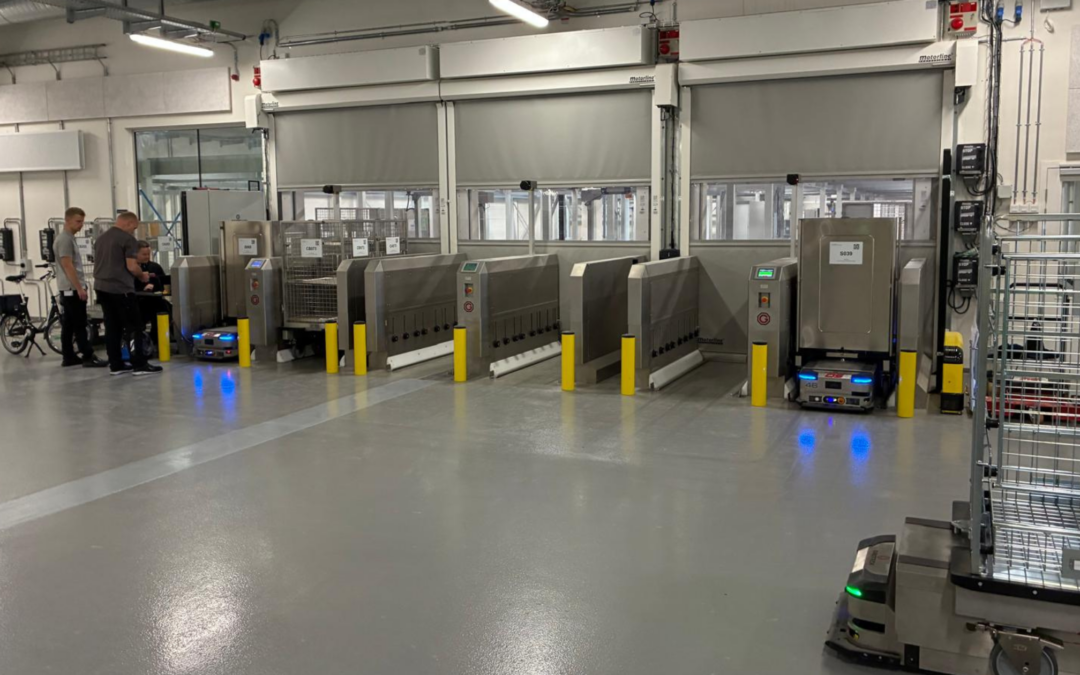
During the day, participants saw examples of automated logistics using bed and trolley AGVs, sterile storage, tracking and localization solutions, as well as the use of RAIN RFID and GS1 standards within the hospital’s logistics infrastructure.
A key takeaway from the visit was that automation does not start with the robots.
For automated logistics to work, the underlying foundation needs to be in place: clear processes, shared master data, unambiguous identification of assets and locations, and integrations that allow systems to exchange information consistently.
This became particularly tangible when participants saw how GS1 standards are used to identify and manage locations and help connect the hospital’s physical environment with its digital systems and workflows.
Concepts such as identification, GLNs and location databases can easily seem abstract when discussed on paper. Seeing them applied in a live hospital environment demonstrated how important they are in enabling automated processes to work reliably.
Tracking and localization were another important part of the visit. In a hospital, beds, equipment, instruments, trolleys and supplies are constantly moving. RFID and localization technologies can provide greater visibility and traceability across these flows and create a stronger data foundation for logistics and operational decision-making.
The visit also highlighted that technology does not operate in isolation. Participants heard about how robots become part of a wider sociotechnical system, interacting with people, workflows, physical spaces and other technologies. What happens around the robot can therefore be just as important as the technology itself.
For many participants, one of the most valuable aspects of the day was the opportunity to see solutions in actual operation and hear open and practical experiences from the first months of use.
The visit provided a strong example of how automatic identification, data capture, standards and automation come together as parts of a larger operational infrastructure – and how the less visible elements, such as master data and standardised identification, are essential to making the more visible automation possible.
AIDC Denmark would like to thank Aalborg University Hospital and Region Nordjylland for opening the doors and sharing their experiences, and all speakers and participants for contributing to an insightful day.